Hospital Innovation:
Why Healthcare Professionals Must Be at the Heart of Change
After three initial articles dedicated to our immersion at La Pitié-Salpêtrière Hospital — exploring the origins of the Innovation Challenges and sharing the stories of projects led by award winners — we wanted to step back and take a broader view: what happens when innovation is born on the ground… and then confronts the system?
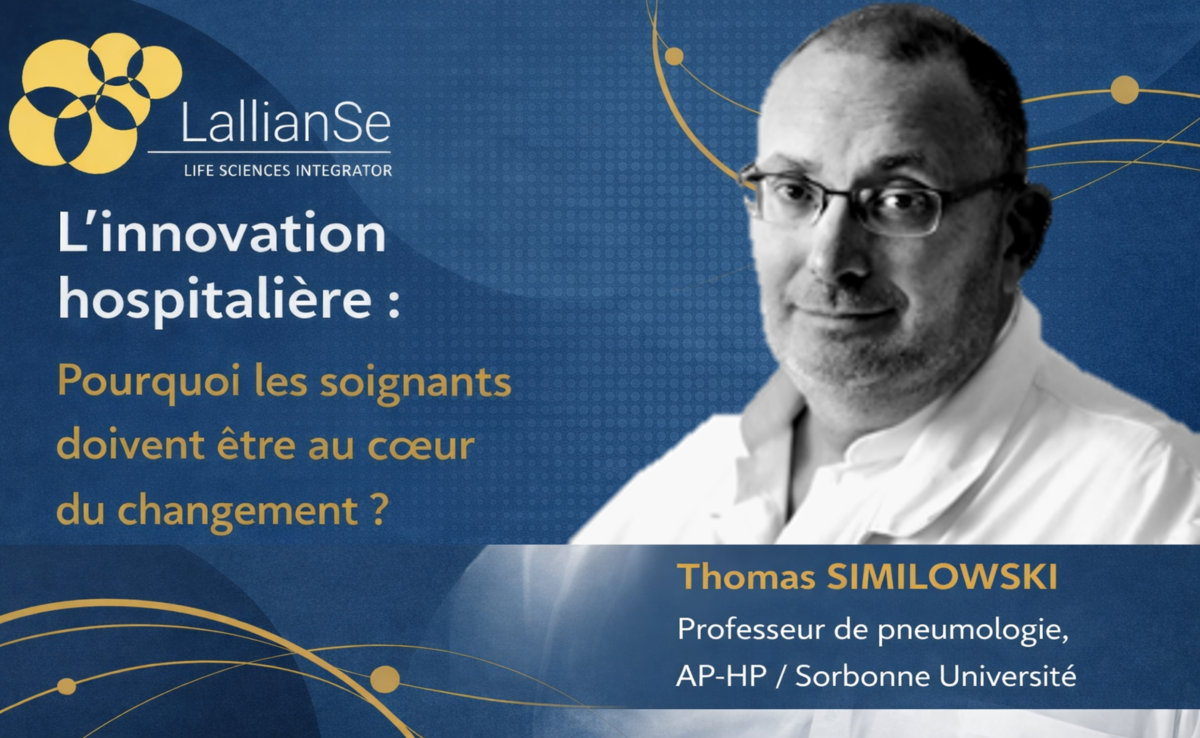
To explore this question, we spoke with Professor Thomas Similowski, Professor of Pulmonology at the Faculty of Health of Sorbonne University and hospital practitioner at AP-HP (Assistance Publique – Hôpitaux de Paris). He heads the R3S Department (“Respiration, Resuscitation, Respiratory Rehabilitation, Sleep”) at La Pitié-Salpêtrière Hospital, as well as the joint research unit UMRS 1158 Inserm – Sorbonne University, “Experimental and Clinical Respiratory Neurophysiology.”
Beyond his medical, clinical, and scientific credentials, Thomas Similowski is also an active player in healthcare innovation, at the crossroads of care, entrepreneurship, and research. He is co-founder and scientific advisor of the start-up AUSTRAL Dx, which develops an innovative contactless digital clinical examination device. He is also co-inventor of around twenty patented devices, processes, and methods, and director of a research unit strongly committed to research valorization, with the support of the Research and Innovation Office of Sorbonne University and SATT LUTECH. His perspective is therefore grounded in concrete and ongoing experience of innovation — from ideation to commercialization.
Before this conversation, we had prepared a structured interview guide designed to address field realities, recognition, attractiveness, barriers, solutions… and above all to give space to a strong conviction: healthcare professionals represent an immense reservoir of innovation.
His message — candid and direct from the very first minutes — disrupted our plan. His vision of innovation within public hospitals is critical and highlights a reality often shared by teams:
“Healthcare professionals have the ideas and understand the needs… but they do not always have the tools to turn those ideas into concrete solutions.”
1) The Field: An Irreplaceable “Sensor” of Needs
The observation is clear: the most relevant hospital innovation does not begin in a meeting room — it emerges from daily practice. It grows out of difficulties, “pain points,” care constraints, complex patient pathways, from what “doesn’t work” and, repeated ten times a day, eventually becomes a need.
Thomas puts it very directly: healthcare professionals “know what needs to be done.” They see what is missing, what causes fatigue, what creates risk, what can be improved — because they live the reality minute by minute. This applies equally to organizational innovation (pathways, coordination, roles, interfaces) and technological innovation (tools, devices, digital uses).
During our discussion, he emphasized that “useful” innovation is often field-based innovation: the kind that makes a procedure simpler, a relationship smoother, or care delivery safer. And this is precisely why healthcare professionals must be at the heart of change — not as a principle, but because they are closest to the evidence: what works, what doesn’t, and what would help.
« Healthcare professionals have the knowledge, they have the ideas.»
But he immediately adds the crucial condition: ideas are not enough.
2) From Idea to Reality: The Real Challenge Lies in the “Conditions”
The discussion highlights a central issue: creativity is not lacking in hospitals. What is lacking are the conditions for success — and sometimes even a framework that does not discourage energy before it has had the chance to become a project.
Thomas describes an ecosystem where people sometimes “see the problems before the solutions,” where caution becomes a reflex, and where administrative pathways can feel like a layering process — the opposite of the initial objective. Even when sharp, his remarks reflect a reality recognized by many project leaders: between idea and deployment lies a series of complex steps (legal, organizational, budgetary, regulatory, among others) that are not always clear to those on the front line. He describes a system that too often discourages before it supports.
He uses a powerful expression to define innovation: “divergent creativity” — the courage to step outside the framework, to propose something different, to imagine otherwise. By nature, innovation challenges what already exists:
« Innovation is a form of disrespect. »
This statement, of course meant metaphorically, conveys an essential idea: you cannot create something new without questioning established habits. The problem arises when innovation is expected to be immediately compatible with all processes, validations, and timelines — as if it must strictly remain “within the box.”
For Thomas, the real issue is not asking healthcare professionals to be more innovative — it is enabling them to innovate without exhausting themselves. He summarizes this shift clearly:
« Healthcare professionals have the ideas, but they don’t have the tools.»
These “tools” are very concrete:
- A clear pathway (who to speak to, in what order, and for what deliverable or objective?),
- Identified contacts (who are the right stakeholders within target structures?),
- Timelines compatible with the urgency of care (rather than an abstract, disconnected pace).
He highlights two key areas where real progress is possible: continuous innovation support processes (including associated professional and individual pathways) and the development of a culture that secures experimentation (including the right to test, prototype… and even fail).
He also points to a very operational difficulty: “even when motivated, you sometimes move forward blindly — because you are told about step one but not step two. And just when you think you are progressing, you fall into a ‘hole’ (administrative, legal, methodological).” The result in the field is predictable: motivation turns into apprehension.
This is a reality: between idea and implementation, the journey is often long, difficult, and filled with obstacles unrelated to the project’s intrinsic quality. According to him, “involving healthcare professionals can ultimately produce the opposite of the desired effect: frustration, disappointment, discouragement. A machine that wears down goodwill.”
3) Paramedical Professionals: Immense Potential… Yet Still Too Invisible
During the discussion, Thomas raised a very concrete and revealing question: when an idea comes from a physician, pathways — however complex — exist. But when a paramedical professional has an idea, where do they go? Who welcomes it? Who responds? Who supports them in refining, exploring, prototyping, or protecting it if needed?
His observation is clear: without an identified and accessible pathway, there is a real risk of dispossession. The idea circulates, transforms, sometimes dilutes… and the original initiator may eventually disappear from the radar.
«The problem is not the idea. The problem is the pathway. And for paramedical professionals, that pathway is neither clear nor visible.»
This is why it is essential to give paramedical professionals a central place in hospital innovation thinking. Their practical expertise is decisive: they are closest to procedures, organizational realities, and daily constraints. Yet innovation pathways remain too structured around traditional codes — publications, research mechanisms — that do not always align with their professional journeys. They must be encouraged to dare to formulate, test, and build.
Thomas does emphasize that awareness is growing. Efforts are underway, institutions are beginning to more clearly identify the place of paramedical professionals in innovation dynamics, and some mechanisms are evolving in the right direction. But, in his view, while awareness is emerging, the road ahead remains long to make these pathways truly visible, accessible, and equitable. The challenge is no longer only to recognize their role in care — but to concretely structure their place in innovation.
This is precisely what emerged from the projects presented in the previous articles of this series. Whether the OB-E Foundation, Pikidou, or T-OUT, these projects were born from paramedical field ideas, carried by healthcare professionals who benefited from structured support. The result? Concrete, deployed, useful projects — and above all, strengthened momentum, both individually and collectively.
When the framework is clear, when support structures are available and guidance is adapted, ideas come to life, project leaders remain engaged, and innovation becomes a lever for recognition.
4) Valuing Caregiver Innovation: A Lever for Attractiveness and Recognition
Beyond projects themselves, a broader issue emerges: innovation can help restore momentum to teams — recognition, pride, dynamism, a sense of usefulness, the desire to build.
Even within his demanding vision, Thomas highlights something valuable: hospitals do not lack talent; they sometimes lack signals that authorize that talent to express itself. He notes that innovation requires “breaking codes.” But if the environment penalizes anything that stands out, the natural reflex is caution.
«We must invite healthcare professionals to board a train that is already moving. »
In other words, if institutions want to attract and retain talent, they must demonstrate that they can transform field energy into results — not merely into endless procedures.
5) What Next? Transmitting, Equipping, Making the Path Reproducible
The conclusion is simple: if we want caregiver-driven innovation to become a collective capability rather than an exception, we must equip and transmit.
Thomas puts forward a powerful idea: learning to “unlearn.” Behind this expression lies a reality: many professionals have been trained to “do things right,” to follow rules and tick boxes — which makes sense in care. But innovating also means learning to explore, prototype, test, and allow for imperfect beginnings.
«We would need training to learn how to unlearn. »
Above all, he reminds us of a key point: innovation is not just an idea. It is a process — from creativity to valorization, and sometimes to transfer. For Thomas, basic pedagogy about the “pathway” prevents fear and disengagement: “At the very least, let’s explain what the boxes are.”
LallianSe’s Perspective:
This interview initially left us perplexed. It clearly highlights the difficulties and the key issues of motivation, support, and long-term commitment. But ultimately, it brings forward a central question: the ecosystem is imperfect — should that lead us to give up?
At LallianSe, our DNA lies in action and construction. What we have learned through years of immersion is that you do not change a system outright — but you can support its evolution through leverage points: spaces of trust, agile and innovative initiatives, renewed interactions between caregivers, innovators, and experts.